Monday, April 29, 2013

Battersea Plantation: Petersburg, Virginia


Dragoon demonstration photo:  Carson[1]  Additional excellent
photography by Ms. Carson can be enjoyed at her webpage.
          From the 19th to the 21st of April, the Battersea Foundation and the 7th Virginia hosted the recreation of the 1781 Battle of Petersburg.  The historical battle pitted militia under Muhlenberg and Von Steuben against Crown forces under Phillips.  Although a loss for the Americans, the battle served as a delaying action.  Lafayette took advantage of the resulting British operational pause to fortify Richmond and prevent an assault on the capital of Virginia.

Battersea [2].
         Battersea was the home of John Banister,  and at various times during 1781 it begrudgingly played host to Cornwallis and Tarleton's Legion.

         Banister was a signer of the Articles of Confederation and owned the successful Banister Saw Mills, which was converted to gunpowder production, bakery and cooperage in support of the Commonwealth during the Revolution.


Christening the 2 pounder Battalion Gun:  "Elizabeth"


An embattled Virginia farmer [3]


Militia in open order do not stand for long... 
they don't stand long in locked formation either, for that matter.

A vedette from Tarleton's Legion.   The reason militia don't stand long.

      Having faced dragoons at Battersea, and without a bayonet, I can say that self preservation will win out when given the option to stand or run in the face of cavalry.   They look mighty big from the ground when your firelock is unloaded.  Militia interpret all orders as option, as a matter of course.
Crown Forces, note the bodies of artillery-men surrounding the gun to their rear.
      This was a great event, though small.  The battlefield sweeps in an arc around the lawn allowing not only an interesting scenario for the engaged forces (cannon and cavalry took part), but allows the spectators to veiw the entire action across about a quarter of a mile. 

      Several sutlers, joiners, acrobats and artist were on hand to support the Battersea Foundation.   Hats of to the Battersea Foundation and Mike Cecere (7th Virginia) for one of the most enjoyable events I have experienced in quite a while.


Camp of the Virginia Militia
             Please visit the Foundation's web page for more on the efforts to restore this beautiful palladian style country house.


                                                   -Cincinnatus


[1] Carson, Stephanie (2013).  Retrived from https://www.facebook.com/WovenThought?ref=stream&hc_location=stream.

[2] ibid.

[3] ibid.

Tuesday, April 16, 2013

Chapbooks: For the middling and mechanicks


Newbury's Pretty Little Pocketbook (1744/1787).

               While searching for references on trap-ball, stool-ball, and rounders (predecessors of cricket and baseball) I came across a collection of chapbooks (a corruption of cheap books) at the Ball State Library. (LINK).  The chapbook spanned all sorts of topics from childrens' literature, religious and political tracts, and...the 18thc century version of the racy novel and was from 8 to 32 pages (one sheet or less).   It is well recorded that the Bible, Robinson Crusoe, Pilgrim's Progress and Foxe's Book of Martyrs were the most widely owned books in the Americas, but perhaps a trademan, soldier, or market hunter might have had one of these in his pocket.  Its very likely. 


University of Guelph, Scotland  (Link)


Nesbitt Chapbook Room, University of Pittsburgh (Link)


 Enjoy.

-Cincinnatus

Thursday, March 28, 2013

18th Century Military Rations, and the lack thereof...


Foraging:  Washington called it thievery until he used his expanded powers
granted by the Congress during the winter of 1777-1778.  Officially and
unofficially smokehouses and barns were liberated throughout the war.

        "According to the saying of Solomon, hunger will break thro' a Stone Wall. It is therefore a very pleasing Circumstance to the Division under my Command, that there is a probability of their marching. Three Days successively we have been destitute of Bread. Two Days we have been intirely without Meat. It is not to be had from the Commissaries. Whenever we procure Beef, it is of such a vile Quality, as to render it a poor Succerdernium for Food. The Men must be supplied, or they cannot be commanded. … The Complaints are too urgent to pass unnoticed. It is with Pain, that I mention this Distress. I know it will make your Excellency unhappy; But, if you expect the Exertions of virtuous Principles, while your Troops are deprived of the essential Necessaries of Life, your final Disappointment will be great, in Proportion to the Patience, which now astonishes every Man of human Feeling." [1]

                                    -Ltr. of Genl Varnum to Genl Washington, 22 Dec 1777.

        In 1775, the best of intentions were made to adequately supply the soldier and militiman that marched against the Crown forces.  The road to Valley Forge, however, is "paved with good intentions".  Understanding that what was authorized was significantly different from what was issued, it nevertheless gives us a good picture of what was available to the soldier in the most ideally plentiful of conditions.  Furthermore, authorized rations generally seemed to follow similar lines throughout provincial and Continental forces.

          Connecticutt-

         "The Order and Direction from the General Assembly of the Colony of CONNECTICUT to their Commissary, for issuing Provisions to the Troops by them raised for the defence of their rights and privileges. — MAY, 1775.           Three-quarters of a pound of Pork, or one pound of Beef, per diem; Fish three times per week.         One pound of Bread or Flour per diem.         Three pints of Beer per diem, or Spruce sufficient, and nine gallons of Molasses to a Company per week.         Half a pint of Rice, or one pint of Meal; six ounces of Butter; three pints of Peas, or Beans, per week.         One pint of Milk per diem.         Three pounds of Candles to a Company per week.         Twenty-four pounds of Soap, or four Shillings' worth, to a Company per week.        Vinegar, two gallons per Company per week.        Chocolate, six pounds per Company per week.        Sugar, three pounds per Company per week.        One gill of Rum per man, on fatigue days only.   Provision made for the Hospital at discretion of the Physicians and Surgeons. The Rations will cost — when Pork is issued, eleven pence per diem; when fresh Beef, ten pence."[2] 

         Massachussetts-

       "In Provincial Congress, Watertown, June 10, 1775.   Resolved, That each Soldier in the Massachusetts Army shall have the following allowance per day, viz:         Article 1. One pound of Bread.         Article 2. Half a pound of Beef, and half a pound of Pork, and if Pork cannot be had, one pound and  a quarter of Beef; and one day in seven, they shall have one pound and one-quarter of salt Fish, instead of one day' s allowance of meat.         Article 3. One pint of Milk, or, if Milk cannot be had, one gill of Rice.         Article 4. One quart of good spruce or malt Beer.         Article 5. One gill of Peas, or Beans, or other sauce equivalent.         Article 6. Six ounces of good Butter per week.         Article 7. One pound of good common Soap for six men per week.         Article 8. Half a pint of Vinegar per week per man, if it can be had".[3]

 
        Finally, the Congressional Continental Ration:

        "1 lb. of beef, or ¾ lb. pork, or 1 lb. salt fish, per day.
        1 lb. of bread or flour per day.
        3 pints of pease, or beans per week, or vegitables equivalent, at one dollar per
       bushel   for pease or beans.
        1 pint of milk per man per day, or at the rate of 1/72 of a dollar.
        1 half pint of Rice, or 1 pint of indian meal per man per week.        
        1 quart of spruce beer or cyder per man per day, or nine gallons of Molasses per    
        company of 100 men per week.
        3 lb. candles to 100 Men per week for guards.        
       24 lb. of soft or 8 lb. of hard soap  for 100 men per week."[4]
          So, the private soldier's individual daily ration, according to the U.S. Army quartermaster's Museum, amounted to:  16 oz. beef, 6.8 oz. peas, 18 oz. flour, 1.4 oz. rice/meal, 16 oz. milk, .1830 oz. Soap, 1 qt. spruce beer and .0686 oz. candle, providing him (albeit theoretically) "...more calories, twice as much protein, an adequate supply of all minerals and vitamins with the exception of vitamins A and C, " than the diet of the WWII infantryman.  [5]

A private's daily ration in the portions noted above,
an ideal rarely realized until the end of the war.
(l-r) salt pork, lye soap, candle stub, pint of hard cider, peas, rice, corn meal

           In reality, the prescribed ration was rarely followed to the letter, whether by design, duplicity, or want.

          "It being represented to the General, that many Regiments would at this season chuse to lessen their Rations of Meat and supply it with Vegetables, if they could be permitted:  His Concern for the health of the troops, and desire to gratify them in every reasonable request, induces him to direct, that the Colonels of such Regiments, as choose to adopt this plan, signify it to the Commissary General, and in two days afterwards the Quarter Master of such Regiment, be allowed to draw one quarter part of the usual Rations in Money to be laid out in Vegetables for his Regiment." [6]


        Diet also changed with proximity to towns and farms that had not yet been picked over by both sides.  Lieut. Jabez Fitch (Jewett's Co., 8th Conn.) had quite a varied diet during the New York campaign of 1776 consisting of varying amounts of milk, rice, cheese, pork, quahogs (clams), turnips, salt beef, biscuit, mutton, chocolate, sugar, rum, tea and toast [7].   Some of this was foraged for, some paid for, and some supplied by the British commissariat (after his capture on Long Island).


Rations drawn by the 10th Virginia , November 1777 [8]

        Due to the challenges of 18th century logistics, in-kind substitutions were often made,  as was the case in baked bread and whiskey for flour and rum.  The entries for the 10th Virginia Regiment (Fig. 8) are characteristic of vagaries and inconsistencies in supply found throughout Assisitant-Commissary McAllister's records.

        Washington even went so far as to order the troops to glean the woods and fields of French Sorrel (similar to spinach), watercress (related to cabbage), and goosefoot (also similar to spinach in taste) to make "sallad" as an anti-scorbutic.[9]


Foraging for "Sallad":  Sprigs of dandelion and wild violet leaves, shown here, 
could be brewed into a bitter tea high in vitamins A, B, C, D
-a reasonably effective remedy for scurvy.

         Rations were also not distributed equally, as in April and May of 1778, were Virginia units on detached duty received soap, but no candles, and the Barracks and Commissary at York received candles, but no soap.[10]  This was probably a function of shortage in general or perhaps their duties during that period.  Nevertheless, Washington continually bemoaned the lack of soap and "sour crout" to Congress, citing their collective abilities to prevent disease.
         
          Sadly, the omission of various portions of a ration was largely due to want, which Joseph Plumb Martin's memoirs jadedly recapitulate,

            "When we engaged in the service we promised the following articles for a ration: one pound of good and wholesome fresh or salt beef, or three quarters of a pound of good salt pork, a pound of good flour, soft or hard bread, a quart of salt to every hundred pounds of fresh beef, a quart of vinegar to a hundred rations, a gill of run, brandy, or whiskey per day, some little soap and candles, I have forgot how much, for I had so little of these two articles that I never knew the quantity.  And as to the article of vinegar, I do not recollect of ever having any except a spoonful at the famous rice and vinegar Thanksgiving in Pennsylvania, in the year 1777.  But we never received what was allowed us.  Oftentimes have I gone one, two, three, and even four days without a morsel, unless the fields or forests might chance to afford enough to prevent absolute starvation. Often, when I have picked the last grain from the bones of my scanty morsel, have I eat the very bones, as much of them as possibly could be eaten, and then have had to perform some hard and fatiguing duty, when my stomach has been as craving as it was before I had eaten anything at all.

Closer to reality:  tough beef and ash cake.  


            If we had got our full allowance regularly, what was it?  A bare pound of fresh beef and a bare pound of bread or flour.  The beef, when it had gone through all its divisions and subdivisions, would not be much over three quarters of a pound, and that nearly or quite half bones. The beef that we got in the army was, generally, not many degrees above carrion;  it was much like the old Negro's rabbit, it had not much fat upon it and very little lean.  When we drew flour, which was much of the time we were in the field or on marches, it was of small value, being eaten half-cooked, besides a deal of it being unavoidably wasted in the cookery.

             When in the field, and often while in winter quarters, our usual mode of drawing our provisions, when we did draw any, was as follows:---a return being made out for all the officers and men, for seven days, we drew four days of meat and the whole seven days of flour.  At the expiration of the four days, the other three days allowance of beef. Now, dear reader, pray consider a moment, how were five men in a mess, five hearty, hungry young men, to subsist four days on twenty pounds of fresh beef (and I might say twelve or fifteen pounds) without any vegetables or any other kind of sauce to eke it out.  In the hottest season of the year it was the same. Though there was not much danger of our provisions putrefying, we had none on hand long enough for that, if it did, we obliged to eat it, or go without anything.  When General Washington told Congress, 'the soldiers eat every kind of horse fodder but hay' he might have gone a little farther and told them that they eat considerable hog's fodder and not a trifle of dog's---when they could get it to eat." [11]

          These problems appear to manifest themselves as a result of the byzantine nature of the Continental supply corps, the failure to grant the army the authority to requisition supplies, and the devaluation of the Continental dollar.  Were it not that Washington was given increasing authority which resulted in the practice of requisition during the winter of 1777-78, tactical supply (Division and below) would not have been able to meet the most basic needs of the army.

          The new supply system began to take shape in 1778, with the shame of mass graves and Valley Forge and the Conway Cabal behind it.  As reported by the Board of War to Congress,


Rations drawn by Col Hartley's Reg't, Apr-July 1779 [12]

           "That the commissaries general of purchases and issues have represented to them, that from the moving state of the army, many parts of the ration, as established by Congress, cannot frequently be obtained, and, from the peculiar circumstances attending the supplies, there is sometimes an over-quantity of one article while others are extremely scarce, some of the states affording greater quantities of meat, while others abound more in flour; and that hence great embarrassments arise in the delivery of the stated ration; and that under such fluctuating circumstances, which change with the motions of the army, it is impracticable and troublesome to apply to Congress on every alteration of situation;'
          
          Whereupon,

           Resolved, That the Commander in Chief of the armies of the United States shall, in the army under his immediate command, and the commander of a separate department shall, in the army under his command, settle and determine according to circumstances, the ration to be issued to the troops, from time to time, giving an over proportion of a plentiful article in lieu and in full satisfaction of such as are scarce or not to be had, and which have been heretofore deemed part of the ration, reporting, from time to time, to the Board of War, the alterations and regulations by them respectively made in this respect..." [13]

            Then as ever, doctrine had to catch up with reality.   The manner in which the soldier was clothed and fed would undergo metamorphosis from tactical logistics to departmental quartermasters, to purchasing agents and back throughout the war.   According to Risch (1981), "It was 1780 before Congress, in the interest of economy, sharply curtailed departmental units of the supply agencies in the military departments.  This reduction was linked to congressional action making the states responsible for providing specific supplies-beef, pork, flour, rum, salt, and forage-to the Continental Army.  Reduction of departmental personnel was increased when Congress later resorted to the use of contracts for such supplies." [14]


                                                                     -Cincinnatus


                "Better is a dinner of herbs where love is than a fattened ox and hatred with it."

                                                                     -Proverbs 15:17


 [1] Letter from Brigadier General Varnum to General George Washington, 22 Dec 1777., retrieved from http://etext.virginia.edu/etcbin/toccer-new2?id=WasFi10.xml&images=images/modeng&data=/texts/english/modeng/parsed&tag=public&part=all, 10 Jan 2013.

[2] Connecticut Authorized Ration, American Archives Series 4, Volume 3, Page 0031., retrieved from http://lincoln.lib.niu.edu/cgi-bin/amarch/getdoc.pl?/var/lib/philologic/databases/amarch/.5867, accessed 11 Jan 13.

[3]  Massachussetts Authorized Ration,  American Archives Series 4, Volume 3, Page 0030., retrieved from http://lincoln.lib.niu.edu/cgi-bin/amarch/documentidx.pl?doc_id=S4-V3-P01-sp01-D0048&showfullrecord=on, 11 Jan 13.

[4] January 4 1775, Journals of the Continental Congress, p. 322., retrieved from http://memory.loc.gov/cgi-bin/ampage?collId=lljc&fileName=003/lljc003.db&recNum=66&itemLink=D?hlaw:1:./temp/~ammem_nzCI::%230030067&linkText=1,  9 Jan 2013.

[5] Retrieved from  http://www.qmfound.com/history_of_rations.htm, 9 Jan 2013.

[6] General Orders, Head Quarters, New York, July 22, 1776. Letterbook, Papers of George Washington., retrieved from http://etext.virginia.edu/etcbin/toccer-new2?id=WasFi05.xml&images=images/modeng&data=/texts/english/modeng/parsed&tag=public&part=all,  10 Jan 2012.

[7] Sabine, W.H.W. (Ed.) (1954).  The New York Diary of Lieutenant Jabez Fitch (NY Public Library manuscript with historical notes), Colburn and Tegg, New York. 27-70.

[8] George Washington Papers at the Library of Congress, 1741-1799: Series 6.
Military Papers. 1755-1798 John McAlister, Assistant Commissary, Provision Returns, October 27,
[9] John McAlister, Assistant Commissary, Records, April-May 1778., George Washington Papers at the Library of Congress., retrieved from http://memory.loc.gov/cgi-bin/ampage?collId=mgw6&fileName=mgw6c/gwpage002.db&recNum=7, 16 Jan 13.

[10] General Orders, Middle-Brook, 9 Jul 1777., retrieved from, http://memory.loc.gov/cgi-bin/query/r?ammem/mgw:@field(DOCID+@lit(gw080196)), 16 Jan 13.

[11] Martin, Joseph Plumb. Private Yankee Doodle,  p. 238.

[12] George Washington Papers at the Library of Congress, 1741-1799: Series 6.
Military Papers. 1755-1798, John McAlister, Provision Returns, 1777; 1778; 1779,. retrieved from,

[13] August 26, 1778, Journals of the Continental Congress, p. 838., retrieved from http://memory.loc.gov/cgi-bin/ampage?collId=lljc&fileName=011/lljc011.db&recNum=424&itemLink=D?hlaw:18:./temp/~ammem_kEQH::%230110425&linkText=1, 9 Jan 2013.

[14] Risch, Erna. "Supplying Washington's Army", U.S. Army Center of Military History Special Study, 1981., p 16.


Wednesday, March 27, 2013

Women in the British Army in America


Soldiers Cooking (1798), after Rowlandson [1]

            Excellent research by Don Hagist on the role of women in the British armies of the American Revolution.  "Women in the British Army in America"  (link) has been published before but has resurfaced via the Museum of the American Revolution.  Good read.  I was very surprised at the numbers involved, although I had read anecdotally in journals about the numbers and the administrative and logistical requirements in accomodating "soldiers' wives". 

British Troops on the March, (1790) [2]

         What is most interesting is the section on employment of women in a support role.  Perhaps we need to revisit having the " ladies  doing the cooking at living history events and expand their roles:  Sutleresses, Regimental Stores, Nurses, Laundresses, Seamstresses, Foragers, etc.   No mention of cooking...lots of other occupations, however.  Even on campaign, apparently:

           "The good woman who had fetched water for us at the risk of her life now got her reward. Everyone threw a handful of money into her apron, and she received altogether more than twenty guineas. In moments like this the heart seems to overflow with gratitude..." [3]
     
        And yet they had the audacity to caricature the French...

French Barracks (1786), Rowlandson [4]


     Here's to the ladies.

                                                     -Cincinnatus


                "She makes linen garments and sells them, and supplies the merchants with sashes.  She is clothed with strength and dignity; she can laugh at the days to come.  She speaks with wisdom, and faithful instruction is on her tongue.  She watches over the affairs of her household and does not eat the bread of idleness.  Her children arise and call her blessed;  her husband also, and he praises her:  'Many women do noble things, but you surpass them all.'  Charm is deceptive, and beauty is fleeting; but a woman who fears the Lord is to be praised.  Honor her for all that her hands have done, and let her works bring her praise at the city gate."

                                                   -Proverbs 31:24-31 (NIV)
   
[1] Rowlandson, T. (1798) Soldiers Cooking, Schutz Engr.  London, Ackerman, retrieved from http://library.brown.edu/cds/catalog/catalog.php?verb=render&id=1196362235781250&colid=13&view=showmods, 27 Mar 13.

[2] Artist Unknown (c. 1790).  Anne S.K. Brown Collection.  retrieved from http://library.brown.edu/cds/catalog/catalog.php?verb=render&id=1170362322937500&colid=13&view=showmods, 27 Mar 13.

[3] Brown, Marvin L., Jr. Baroness von Riedesel and the American Revolution: Journal and Correspondence of a Tour of Duty, 1776-1783. The University of North Carolina Press, 1965. p. 60., as quoted in Hagist, D. L. (2002). 

[4] Rowlandson, T. (1786).  French Barracks, London:  S.W. Fores.  retrieved from http://images.library.yale.edu/walpoleweb/oneitem.asp?imageId=lwlpr19317, 27 Mar 13.

Monday, March 25, 2013

Captain John Outwater's Company of Militia, Bergen County, New Jersey

Battoemen at the Battle of New Bridge, New Jersey

War of the Outposts

Battle of Paramus Church
 Facebook:    Outwater's Company

Webpage:     Outwater's Company

Interesting sites to check out from a great looking New Jersey militia unit.


    -Cincinnatus

Friday, March 22, 2013

You asked, we answered: What did Revolutionary War soldiers have in their pockets- Smithsonian Blog Link

Gansvoort Regimental
National Museum of American History Blog:

"You asked, we answered: What did Revolutionary War soldiers have in their pockets?

Linda B. asked through our Facebook page: 'I have a research question … What kinds of things would Revolutionary soldiers carry in their pockets? Did they have pockets or did they use backpacks instead?'
Here's our answer, supplied by Marko Zlatich, a longtime volunteer in the museum's Military History Department..."


Interesting Blog entry...


                                               -Cincinnatus

Wednesday, February 20, 2013

Tents: Procurement and Materials in the Continental Army

Bunbury, British Camp, 1790 [1].

         Recently, a friend sent me a link for a blog article (excellent blog by the way) in which he was featured that also had a picture of "18th c" tents on it.  The tents in question were cotton canvas, machine stitched, and fire retardant.  I could tell this immediately from the photo.  How, you may ask?  They look exactly like the ones from my unit, with the exception of a few of the painted numbers.  This is something that has bothered me ever since I got a look at Washington's marquis and the marquis at Yorktown a few years back.  It does not have any of the aforementioned three anachronistic qualities as the tents in our organizational equipment.  So the article brought up the issue of improving camp impressions in several areas, to include tentage material.  I think this is a good direction, but its a little more complicated than saying, "Let's switch to linen."
         The problem of shelter for the 18th century soldier, particularly Continental forces, met with similar obstacles as clothing, rations, and forage.  My hypothesis is little more that this:  The private soldier did not sleep under a cotton canvas, machine stitched, fire-retardant tent. That was easy...so what did he sleep under? 
          My guess is that like that most facinating of gentlemen in the Dos Equis commercial, he would say,"I don't often sleep in a tent, but when I do, I sleep under ________." (Insert a myriad of different fabrics). This is the first of what I hope will be many discussions on tentage:  procurement, materials, design, cantonment-not to mention the alternatives to it.  I think alternatives to tents is perhaps even more important than the tent itself, since there was a persistant shortage throughout the war and units rarely carried them on active service away from the main army (keep in mind Washington was fighting a "War of Posts" that involved "Flying Camps" and small unit actions-Giap-of  Indochine/Vietnam War fame was a great admirer). I say discussion when I refer to this research, rather than article, as with the increasing availability of digitized and transcribed information at university and free libraries, it is my hope that we can spark a conversation and find even more information than my small offering. 

PROCUREMENT


         Initially, tentatively setting precedents for its limited authority, Congress intended  to have the various colonies supply their militia in continental service directly. 

         Virginia had already seen fit to do so with the first two regiments it fielded in 1775, intending to provide one tent for each officer, one for every two serjeants, one for every two musicians, one for every six privates, and a bell tent for every company. [2]  This was at least the lofty goal in the initial days of the war, when even before the 1st and 2d regiments were formed at Williamsburg,

           "A camp is now marked out, behind the college; tents and other camp equipage are getting ready with the utmost expedition; and the troops, from the different counties are on the march for this city..." [3]

Artist unknown, French Camp, 1779. [4]


           When you consider the distances involved for Virginia to supply its forces in New York or New Jersey in 1776-77 the task becomes nearly insurmountable.  Shipments from Virginia were forthcoming, but could not meet the needs of its brigades in Continental Service.  This not being sufficient or efficient, Congress turned directly to contractors.

          "Mr. J. Mease having, in consequence of the resolution of the 30th August, made a report, that he cannot find there is any cloth in this city, fit for making tents, except a parcel of light sail cloth, which is in the hands of the Marine Committee: Whereupon,

Resolved, That the Marine Committee be directed to deliver to Mr. J. Mease all the light sail cloth in their hands: And that Mr. Mease be directed to have the same made into tents, as soon as possible, and forwarded to General Washington:

 That the Secret Committee be directed to write to the continental agents in the eastern states, desiring them to purchase all the duck and other cloth fit for tents, which they can procure in their respective states, for the use of the continent." [5]

       In October of 1776, Congress planned to procure 5,000 tents for the spring campaign of 1777, suggesting that the Continental Army was intended to build huts in fortified cantonments in the winter similar to European armies. [6]

       Unfortunately, their interest in the matter was more often merely an admonision to a general to "...order the deputy quarter master general of the eastern department, forthwith to provide 1,000 good bell tents, and send them to the army..."[7], rather than ensuring that the cloth or tentage was actually acquired and on hand.


Detail from "Accurate...",  by Will, 1788 [8]
Notice the narrow width of the fabric panels seams.  While this scene
is probably located in Austria, Will did serve in North America
with German troops in British service during the Revolution. 

MATERIALS


       We have already seen sail cloth and duck used for tent material, as an expedient-and expediency was the order of the day.  In practice, it seems any type of fabric deemed heavy enough and to have a tight weave was used in the production of tents.


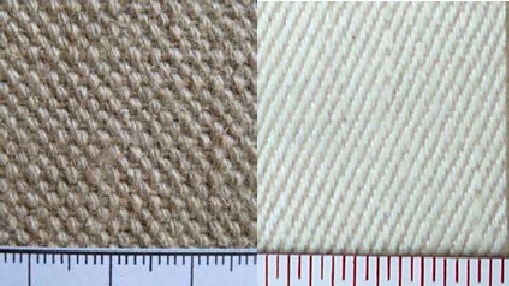
Hemp Canvas                                      Hemp Russia Drill

       "That the Board of Admiralty take order for supplying the quarter master general with such quantity of the duck and Ticklenburg belonging to the United States in possession of the Navy Board at Boston, as he may have occasion for, to compleat the number of tents wanting for the army, and which can be spared from the immediate use of the navy" [9]

        Ticklenburg was a coarse linen fabric manufactured in Ticklenburg, a german town near Osnabruk (Osnaburg), which suggests that the two fabrics (ticklenburg and osnaburg) were probably similar in weave and weight.  Both were used for coarse working applications and were exported to North America  and the West Indies.

Linen Osnaberg                                      Linen Duck Canvas

       "That John Bradford, continental agent at Boston, be and hereby is directed to sell all the canvas in his possession, except what the Navy Board of the eastern department
may deem sufficient for the immediate use of the navy, or suitable for soldiers' tents..." [10]

        "We have stripped the seaports of canvass to make tents; and it is of great importance to possess ourselves of about five hundred pieces of Ravens duck to keep the soldiers in health." [11] 

        "Pursuant to your order, I have purchased, on the publick credit, 261 Ravens Duck that is in Town; also, 26 bell-tents, and 635 haversacks, of Mr. Levy; one bell and one officers' tent, from Captain Devereux. I have delivered, 137 pieces duck to the tent-makers, out of which they have made 250 tents, which are finished, and in my store. There remain 124 pieces duck in my hands, which will make about 227 soldiers' tents more." [12]

Detail from "North view of Fort Royal in the Island of Guadaloupe,
when in possession of His Majesty's forces in 1759",
after Campbell, 1764. [13}

Again notice the vertical seams, consistently showing seven panels
on the enlisted tents.  This engraving was struck after a sketch by a
leftenant serving on Guadaloupe.
         "Ordered, That Mr. Peter T. Curtenius, as Commissary of this Congress, be desired to purchase the following quantities of Ravens Duck, Ticking, and Bell Tents, of such persons as will sell the same on the publick credit, to wit: 427 pieces of good Ravens Duck; 182 yards of Ticking, fit to make Bell Tents; and twenty-six Bell Tents, which are at Hayman Levy' s, if they are of a proper fashion, good, and of a cheap or reasonable price." [14]

          "Mr. Van Zandt, from the Committee appointed to get as many Tents made as they shall think necessary, reported, that they had agreed with sundry Upholsterers to make two hundred and fifty Tents, and to furnish all materials (Duck excepted) for making the said Tents, with Tent Poles, Mallets, and other necessaries for the said Tents, at the rate of fifteen Shillings for each Tent. That the said Upholsterers have agreed with them to have the said two hundred and fifty Tents finished by the latter end of next week..." [15]


[1] Bunbury, H. W. (1790), British Camp Scene. watercolor. Anne S. K. Brown Collection.  Retrieved from http://library.brown.edu/cds/catalog/catalog.php?verb=render&id=1163520244421875&colid=13&view=showmods

[2] The Proceedings of the Convention of Delegates of Virginia, July 17 1775.

[3] Purdie's Virginia Gazzette, September 29, 1775, p. 2.

[4] Artist unknown, (1779), French Camp., watercolor. Anne S. K. Brown Collection.  Retrieved from http://library.brown.edu/cds/catalog/getimage.php?image_id=1140643012531257.jp2

[5] Journals of the Continental Congress, 1774-1789. vol. 5, Septempber 4, 1776, p 735., Retrieved from  http://memory.loc.gov/cgi-bin/ampage?collId=lljc&fileName=005/lljc005.db&recNum=319&itemLink=D?hlaw:2:./temp/~ammem_VKFY::%230050320&linkText

[6] Journals..., 840.

[7] Journals...vol. 10, 24.

[8] Will, Johann Martin, (1788) "Accurate Vorstellung so sich nach der erobrung von Schabaz den 24 April 1788, zwischen ihro Majestät dem Kayser, und General Lasen begeben",  Retrieved from http://library.brown.edu/cds/catalog/getimage.php?image_id=1145655105468750.jp2
[9] Journals...vol. 17, 509.

[10] Journals...vol. 18, 911-912.

[11] Gerry, Elbridge.  Letter to Massachussetts Delegates., June 4, 1775, [S4-V2-p0905], Retrieved from http://lincoln.lib.niu.edu/cgi-bin/philologic/contextualize.pl?p.3593.amarch.1288

[12] Curtenius, Peter T., Letter to the New York Provicial Congress.,  June 28, 1775, [S4-V2-P01-sp32-D0576], Retrieved from http://lincoln.lib.niu.edu/cgi-bin/philologic/contextualize.pl?p.4043.amarch.608


[13] Lt. Campbell, A (1759).,  North view of Fort Royal in the Island of Guadaloupe, when in possession of His Majesty's forces in 1759, Engraving by Charles Grignon, London:  Jeffrys (1764), Retrieved from  http://library.brown.edu/cds/catalog/catalog.php?verb=render&id=1327437137625001&colid=13&view=showmods

[14] Orders. New York Congress., June 16, 1775,  [S4-V2-p1303], Retrieved from http://lincoln.lib.niu.edu/cgi-bin/philologic/contextualize.pl?p.4416.amarch.286


[15] Orders. New York Congress., June 17, 1775, [S4-V2-p1303], Retrieved from http://lincoln.lib.niu.edu/cgi-bin/philologic/contextualize.pl?p.4418.amarch.781