Wednesday, October 23, 2013

Final advance on the British works at Gloucester: Warner Hall, The Battle of the Hook, 1781


The Virginia Brigade advances on the Crown's lines at Gloucester,
led by the 3d Dragoons and squadron of the Marquis d'Lauzun.

Video of the advance of the Allied Forces under General Weedon and the Marquis de Choisy here:  First Virginia Regiment of the Continental Line.


Tuesday, October 22, 2013

Franco-American Boat Landing, Battle of the Hook: Gloucester, Virginia: 1781

Franco-American Landing at Warner Hall:  Battle of the Hook

         The First Virginia Regiment of the Continental Line hosted the recreation of the October act ions against Tarleton and Company at Gloucester Point a series of engagements that ultimately took away options for Cornwallis across the river at Yorktown in 1781.  Video of the amphibious landing is here:  Virginia Regiment of the Continental Line.


Sunday, October 6, 2013

White Oak Canyon Scout: Testing your kit in foul weather

A Virginia Spy makes his way to a cold camp.  In the rain, I keep my lock under my arm,
instead of keeping my firing hand on over the wrist.  I keep the muzzle down, to reduce the
amount of moisture in the barrel (I never put a tompion on a loaded firelock).
                 "I was born in Prince Edward County, Virginia in 1764, and moved to the Clinch with my father when it was yet Botetourt County (prior to 1773). I was called out as a volunteer at Blackmore's Fort under Captain Joseph Martin in the spring of 1776, while I was yet a boy, but well grown." 
-Alexander Ritchie, Indian Spy[1]

               It is a rainy weekend in Virginia.  Not a day for a scout, but perfect weather for war.  You see, rain muffles the sounds of movement.  It is good weather in which to attack...provided you can keep your powder and lock dry.  That was the aim of this scout.  I am a lone "Spy" on the Virginia frontier.  It could be 1763 or 1793.  Either way there were men who would go out alone in times of trouble to sit in silence and watch the passes though which the war paths crossed.

              My aim was to test my equipment.  I want to stay dry, be unseen, and be able to fight and withdraw.  Specifically, I want to test the waterproofing on my moccasins and for my firelock.  For my moccasins I used a combination of beeswax and neet's foot oil.  Lard was used during the 1800's and reapplying grease to your moccasins was a daily chore.  Part of looking after your acoutrements.  The first time I greased this particular pair, I ensured that my concoction was hot to allow it to permeate into the leather.  Now, I simply slather it on and work it in.

The heights offered  poor visibility of the pass in such dense brush. 
There's no good place to hunker down and nothing to cover my back.

                  "...In this fort there was constantly about 20 or 25 men besides the spies. The Indians were not so troublesome in the immediate vicinity of Moore's fort, but they were more troublesome lower down on Clinch and Powell's Valley. In August the Wyandots [sic, Wendat] from the north appeared in our vicinity. When out he saw Indian sign. Three persons only were killed in his neighborhood, to wit: John English's wife, Molly and two of her little boys. The Indians retreated down Sandy and they were pursued by the spies as well as the others who remained in the fort to guard it. We were unable to overtake the Indians. They had stole some horses. These are the particular circumstances that I now recollect of. The spies had particular sections allotted to them, where the war paths of the Indians passed, and some time we would not return unless Indian signs were seen for a month, but in August and September the Indians were always most troublesome in stealing, murdering, and burning. The spies below had a running fight with the Indians and they retreated. This was with the lower squads..."

                                                                          James Fraley, Clinch Spies c.1779[2]

                  The second goal was to keep my firelock dry.  This I did by loading down in the "settlements" at the base of the trail and applying my mixture of beeswax and turpentine (a waxy paste) around the pan, once the hammer (frizzen) was seated firmly on top (after loading).  I am careful not to get any wax on the strikeface of the hammer.  I then cover the lock with my cow's knee.  I would note that the use of beeswax and turpentine (camphor) rubbed into the barrel also makes an excellent rust preventative.  See my previous post on Period Methods for Cleaning your Firelock.

Greased moccasins lined with an old blanket and a greased cow's knee. 
These are virtually impermeable and keep feet and firelock in working order.

                  My  cow's knee is simply two pieces of scrap leather (from the moccasin project) that are sewn together to fit snugly over the lock.  Mine extends from just behind the swell in the stock (in front) to cover below the thumb escutcheon (in rear)  It is tied in front and back with leather thongs or whangs.  I tie it tight in back and just wrap the thongs around the stock in front.  This way I can pull it on and off to load/fire without taking the who off the firelock.

                 I took with me the following:

Firelock
Powder Horn
Shot pouch (Shot, ball, turn screw and vise, patches, oil, worm, vent pick, whisk, rag, beeswax mixture)

Blanket and Tumpline, Canteen, Tomahawk
Knapsack (This is waxed with pure beeswax, and the contents say bone dry):  Knitted cap, Cup, spoon, food (venison, bread, cornmeal, tea), spare stockings, moccasin grease

I wore:  Body Shirt, waistcoat, trowsers, stockings, leather leggings (also well greased and tied at the knee with fingerwoven garters) moccasins, flopped hat, kerchief, leather belt, and hunting shirt.

I carry my firemaking kit and some food in my waistcoat pockets.
    
A cold camp in the lee of a rock.
              I chose a spot where I could see the trail, the opposite ridgeline, and was protected from behind.  This would have been a cold camp, that is no fire.  A meal of bread and dried venison, water.  The rock sheltered me from the rain and wind, while allowing me to see the trail and valley below.

Crossing White Oak Creek again...

          Perhaps I see a war party now, maybe a day or two later.  As a spy, I am to warn the settlements, not engage a warparty coming through the pass.  Nevertheless, my firelock must be ready.  As I move across the creek, they are within earshot, the metal of my tin military canteen clanks against the head of my tomahawk.    I know they are alerted by the whoop I hear.  I slip the cow's knee off the lock.  The pan is still sealed.  I tree and fire as the first warrior comes into view.  A slow ignition, but the charge is touched off.  The first brave drops, but a second overtakes him.  I leap up from my tree and scramble down the creek bed, shielding my pan under my arm and reloading.  A second shot.  This one a faster ignition.  The warriors pull back to regroup.  My lock has stayed dry despite the rain and I am back down the valley to the settlement

        I  am in fair shape once I take off my leggings and hunting shirt.  My feet are dry after deluge and submersion in the creek when I skedaddled.  My firelock ignited satisfactorily (albeit only twice) in a downpour.  A pretty successful day.  The only drawback was the reason I had to fire in the first place.  That noisy tin canteen...this made me think, wood is clearly better than tin for this sort of work.  I'm a scout west of the Blue Ridge...would I have a military pattern water carrier.  Probably not.  Perhaps a glass bottle?  Perhaps a wooden rundlet?  Need to look into that.  I think a tin canteen on a frontier scout is neither quiet not appropriate...at least I've proven the first.

[1] Pension Papers of Alexander Ritchie, Claiborne County, TN (1835), R-8784.

[2] Pension Papers of James Fraley, Floyd County, KY (1834), http://revwarapps.org/r3736.pdf, accessed 06 Oct 13.

Thursday, May 9, 2013

Extant British Blanket c. 1776


Note the two single yarn blue stripes along the edge,
faded broad arrow and GR cipher.


                   This blanket is in the collections of the Duxbury Rural and Historical Society, donated by the descendant of Captain Gershom Bradford. Check out the entire blog post:  Evacuation Day and a Discarded British Blanket at Historical Digression.


                         -Cincinnatus

Tuesday, May 7, 2013

In search of historical markers: the Gunpowder Incident, Gloucester Point...

The Magazine at Williamsburg:  Provincial or Royal property?
          I have always been fascinated by the events of spring, 1775 in Virginia, to which we today refer as the Gunpoweder Incident.  Generally speaking, this involved Royal Governor Lord Dunmore's authorization for Royal Navy personnel to confiscate provincial arms powder stores in Williamsburg, securing them aboard Royal Navy shipping. As events unfolded there are political agitators (Patrick Henry), enraged gun-toting farmers (the Hanover Militia) and provincial bureacrats (Receiver General Richard Corbin) caught up in the fury.  What's not to like, this is the kind of stuff  worthy of the Drudge Report!

Virginia Gazette [1]
         I am currently conducting research into routes, sites and events associated with the Gunpowder Incident (1775) and the march South to Gloucester (1781) in planning preservation march events.  In my search I came across a helpful site (link), Colonial America.com that locates State Highway Historical Markers.  Pretty useful, and user friendly!

Historical Marker, Site Map locator:  A Useful tool
Hope you enjoy this tool as much as I did.  Apparently, if we march to Laneville to demand payment from Richard Corbin (Provincial Receiver General) for the gunpowder, we're crossing the Pamunkey and Mattaponi in flatboats!

[1] Virginia Gazette.  Retrieved from 
http://research.history.org/pf/declaring/gunpowder.cfm

Wednesday, May 1, 2013

18th century trousers for ne'er-do-wells, if the shoe fits...


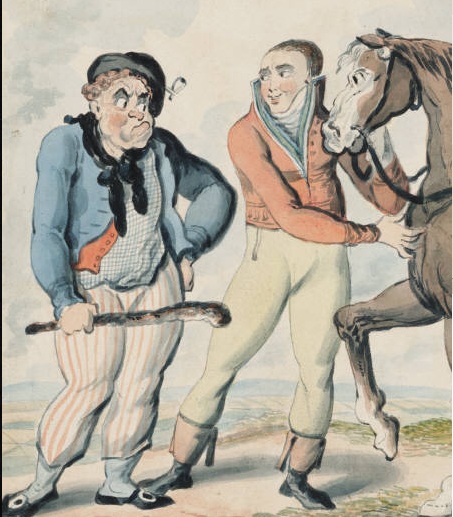
Jack and Ostler in trousers [1]  Two of my
favorite recurring "ne'er-do-wells".
       ...And so, on to trousers, or is it trowsers?  I find it interesting that, like the sleeved waistcoat/stablejacket of a few weeks past, we find the sailor and the ostler dressed in similar fashion.   Apparently cartoonists liked this juxtaposition as well.  Perhaps because there was an on-going competition for the uppermost of the disenfranchised and lampooned of the bottom two rungs of the social order?

      In any event, I decided to make a pair of trowsers that would be appropriate to the farrier, farmer, mechanick and Jack Tar.  There are actually a lot of visual references for the last half of the 18th c, which led me to make a pair that were close fitting and hemmed above the ankle (as the vast majority seem to have been).

Details from "An Englishman" [2], "The Jealous Clown"[3], "Jemmy's Return"[4]
     You will note from all three examples that the petticoats are under siege.  The randiness of Jack Tar was a well-liked theme, for certain.  In any event, the fit of breeches and trousers in extant art and frustrating experience has shown that I am better off making my own patterns to achieve the proper fit.  This I did on brown paper after taking detailed measurements.  The initial piecing went well enough, with a tow linen and some striped lined scraps for the lining.  The exception to "well enough" were the pockets and the waistband.

l-r 1.  Pinning the interior pockets, 2.  Side pocket detail,
3.  Fall Front, 4.  Rear gusset, eyelets.
      Making the pockets inside out and backward caused me to break out the seam ripper more than once.  I also had to reduce the waistband and increase one pleat on the rear panels...that's a good thing!  Yes you do see machine zig zag in the upper left, I only had four days to work on these before Battersea.  Normally I do a hand blanket stitch to prevent the linen from fraying.


A "Ne'er do well" at Battersea, Petersburg, Virginia
Photo Credit:  Carson [5]

      In the end, the trousers were ready for the Battersea event.  I'm happy to say received a great compliment second hand, "Who is that guy from the First Virginia?  He looks like he actually works in his clothes."  He obviously didn't know about the zig-zag that lieth beneath.
      I'm loath to share that-the compliment, that is, but it helps me to make a point about some vitriolic posts I've seen online recently directed at newcomers.   At eighteen I farbtastically showed up to an ACW event in Williamsburg in a poly-wool blend non-1862 uniform with a fur bowie-knife scabbard. I know, I know!  Falling in with a "hardcore-progressive-campaigner unit", the snide comments made me actually do the research to scrap that and better my ACW impression-but then again I have tough skin...not everyone does.  I always remember that feeling when I see clothes that don't fit right, or accoutrements that are clearly off the rack from a sutler, or the proverbial stainless steel canteen or haversack-at-the-knees.  I'm still learning (after nineteen years in living history), which is the nice thing about seeing other "maker's" blogs for the "how to" and the rapid proliferation of online repositories (see links to the right) for the "why-for".  But I hope that I complement and encourage, more than tear down or create division (and give credit where credit is deserved).


                                                                  -Cincinnatus 


       "These six things doth the LORD hate: yea, seven are an abomination unto Him:  A proud look, a lying tongue, and hands that shed innocent blood.  An heart that deviseth wicked imaginations, feet that be swift in running to mischief, A false witness that speaketh lies, and he that soweth discord among brethren."

                                                                  -Proverbs 6:16-19


[1] Newton, Richard. (1797), The Long Horse., Laurie and Whittle, London.  Retrieved from

[2] Dighton, Robert. (1781),  An Englishman taking a French Privateer, Carrington Bowles, London.    

[3] Collet, John. (1778), The Sailor's Present or the Jealous Clown, Carrington Bowles, London.

[4]  Artist unknown.  (1787), Jemmy's Return., Robert Sayer, Fleet Street, London.  Retrieved from

[5] Carson, Stephanie (2013) Retrieved from


Monday, April 29, 2013

Battersea Plantation: Petersburg, Virginia


Dragoon demonstration photo:  Carson[1]  Additional excellent
photography by Ms. Carson can be enjoyed at her webpage.
          From the 19th to the 21st of April, the Battersea Foundation and the 7th Virginia hosted the recreation of the 1781 Battle of Petersburg.  The historical battle pitted militia under Muhlenberg and Von Steuben against Crown forces under Phillips.  Although a loss for the Americans, the battle served as a delaying action.  Lafayette took advantage of the resulting British operational pause to fortify Richmond and prevent an assault on the capital of Virginia.

Battersea [2].
         Battersea was the home of John Banister,  and at various times during 1781 it begrudgingly played host to Cornwallis and Tarleton's Legion.

         Banister was a signer of the Articles of Confederation and owned the successful Banister Saw Mills, which was converted to gunpowder production, bakery and cooperage in support of the Commonwealth during the Revolution.


Christening the 2 pounder Battalion Gun:  "Elizabeth"


An embattled Virginia farmer [3]


Militia in open order do not stand for long... 
they don't stand long in locked formation either, for that matter.

A vedette from Tarleton's Legion.   The reason militia don't stand long.

      Having faced dragoons at Battersea, and without a bayonet, I can say that self preservation will win out when given the option to stand or run in the face of cavalry.   They look mighty big from the ground when your firelock is unloaded.  Militia interpret all orders as option, as a matter of course.
Crown Forces, note the bodies of artillery-men surrounding the gun to their rear.
      This was a great event, though small.  The battlefield sweeps in an arc around the lawn allowing not only an interesting scenario for the engaged forces (cannon and cavalry took part), but allows the spectators to veiw the entire action across about a quarter of a mile. 

      Several sutlers, joiners, acrobats and artist were on hand to support the Battersea Foundation.   Hats of to the Battersea Foundation and Mike Cecere (7th Virginia) for one of the most enjoyable events I have experienced in quite a while.


Camp of the Virginia Militia
             Please visit the Foundation's web page for more on the efforts to restore this beautiful palladian style country house.


                                                   -Cincinnatus


[1] Carson, Stephanie (2013).  Retrived from https://www.facebook.com/WovenThought?ref=stream&hc_location=stream.

[2] ibid.

[3] ibid.