Wednesday, December 5, 2012

Prickett's Fort


Prickett's Fort was built in 1774, by Jacob Prickett, during Dunmore's war as a private fort where families from the Monongehela Valley could "fort up" in times of Indian Attack.  During the revolution militia under Colonel William Haymond operated from its walls.  Today, its a West Virginia State Park, and this weekend (Dec 7-9), the non-profit Memorial Foundation associated with the fort is holding their market fair... which I wish I could get out there this year...maybe next year.


      -Cincinnatus

Photo by Jacob Turner

Monday, December 3, 2012

Christmas at Carlyle House, 1777.

        After leaving the walls of Fort Mifflin and the return of its rifle companies from the victories at Saratoga in 1777, the First Virginia settled down for the winter at Valley Forge.  A few fortunate souls returned to Virginia on recruiting duty, to fill the vacant ranks.
        On December 1st, we made our way to Carlyle Historical Park in Alexandria Virginia.  Carlyle House was the home of John Carlyle, second son of a Scottish Baron.  Carlyle established his import business just prior to the Seven Years War near what was a tobacco warehouse in a village that would become the colonial seaport of Alexandria, Virginia.  Carlyle married Sarah Fairfax, securing his place in the Virginia aristocracy.  He was also the particular friend of George Washington and served as commissary general to the Virginia Forces in both the Seven Years War and the American Revolution.

Preparing the fire for some liberated chickens.
Alas, the chickens sentenced.


Loafing...we seem to do quite a bit of this,

Captain Dean, of the artillery,  haranguing the crowd,
as he is often wont to do


Roast chicken, skeletonized.

Mrs. Sarah Fairfax Carlyle at her embroidery

Take one fiddler, add a handful of soldiers and one punchbowl of lemon shrub:
instant party.
The local chirgeon.
             Old Saw-Bones, lurking in the Carlyle's cellar.  I believe I'll return to the fiddler and the lemon shrub. I've a better chance of keeping all my limbs.

Firing the Christmastide Guns

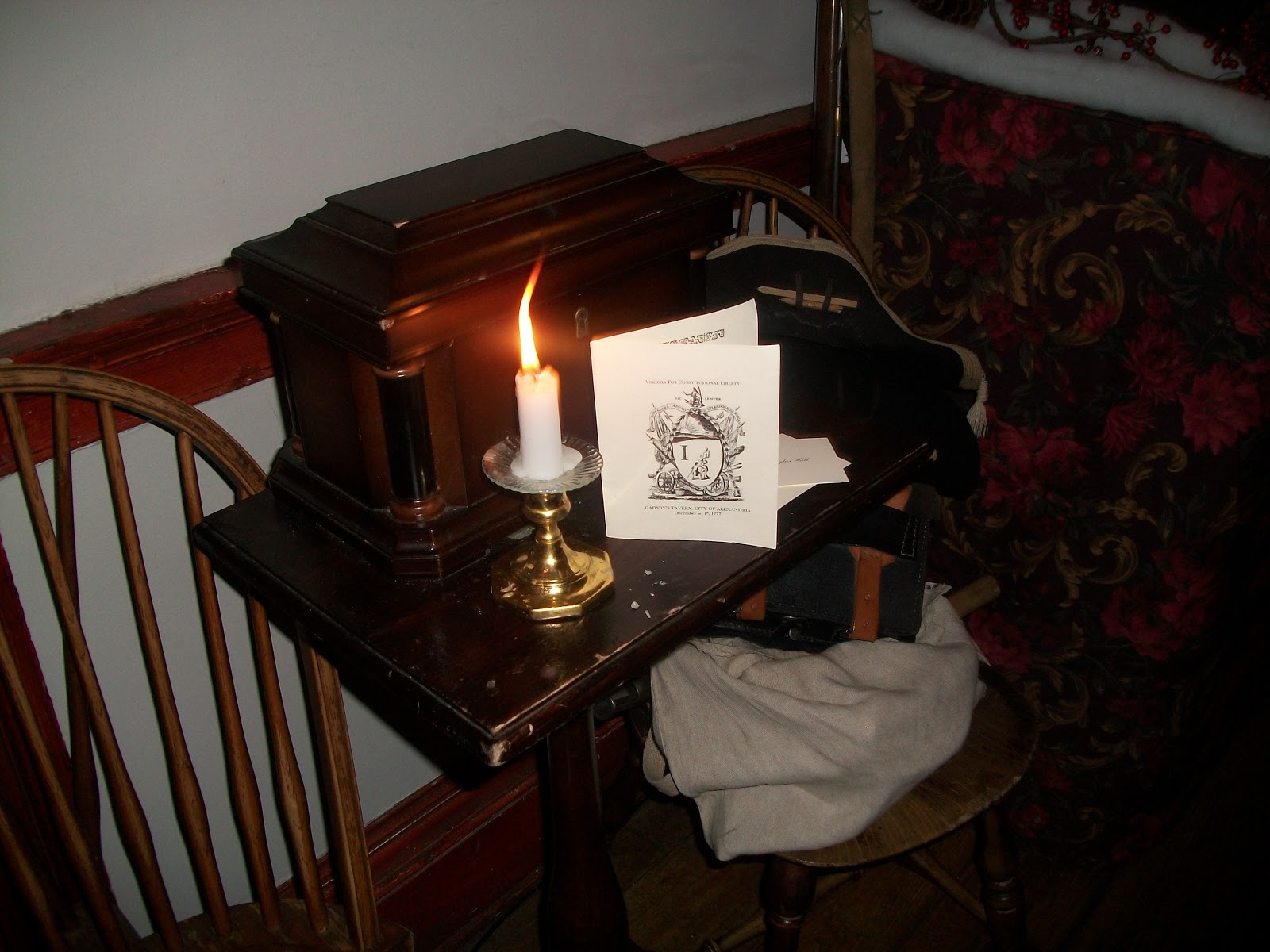
        Then off to Gadsby's Tavern for an evening of yuletide merriment, "fathoming a bowl" of lemon shrub, ale, &c, &c.  Our annual "mess night" gave us an opportunity to pour over the latest copy of the Virginia Gazette, enjoy each other's company, recall the follies and misfortune as 1777 winds down, and attempt a few songs, to the melodies of Mr. Hall's English guitar.


A memento of our Mischianza.

Mr. Hall regaling the party with his loquatious wit.


Tuesday, November 20, 2012

Revolutionary Physick?

Hugh Mercer's Apothecary Shop, Fredericksburg, Virginia, ca. 1775.

                    Fredericksburg, Virginia was once the sight of a major Continental Army hospital at the intersection of Caroline and William Street. BGen Hugh Mercer practiced medicine in Fredericksburg before the war, but was killed in the New Jersey Campaign before the establishment of the hospital. Mercer’s Caroline Street office and apothecary shop is a now historic site, currently managed by Preservation Virginia, and many of the "medecines" found there were used at the military hospital. From Jefferson’s papers we find a list of medicines used in the hospital in that day. Several thoughts are born of this list, 1. Continental doctors thought that copious bowel movements and/or vomiting were the best treatment for just about every ill, based on the amount of emetics, cathartics, and laxatives that were kept in the medicine chest, 2. There was a lot of syphilis in the Continental Army…or at least in the Virginia and Maryland line. I suppose that playing cards, hazards, or the occasional Game of Goose were not the only recreation in the army.

                                                                                                                            December 28 1780
        Sir,
               I am persuaded your Excellency and the Honble. Council will pardon the liberty of this address, as It’s intended to relieve the Distress of the Soldiery that may occasionally be in the Hospital here.
               Doctor Rickman in September last wrote me to take Charge of the Hospital at this place and at present to find Medicine for them, Which should be repaid. I did so, and until this time attended, and found Medicine for a great many of the Virginia and Maryland Line that were ordered by the officers to be taken care of. This I carefully attended to, and sent them all away to their respective Corps except three that shall shortly be sent forward.
               As It’s not in my Power to find Medicine much longer out of my private stock for Practice, I take liberty of sending an Invoice of such as may be absolutely necessary for the Sick and wounded, to request that they may be ordered to this place, and they shall be Carefully kept for that particular purpose. As I have purchased Medicine at a very dear Rate for 12 months past, and never received any Payment or Emolument for Services done, I hope your Excellency will direct me and order payment in that Line, as I am unacquainted with the mode of application. 

I am with profound Respect, Your most Obt Hble St.

                                                                                                                            Chs. Mortimer

                           ENCLOSURE

Jallap              Tartar Emetic         Mercurial Ointment
Ipeccachuan    Glauber Salts          Quicksilver
Rhubarb          Calomel                  Cream Tartar
Salt Peter        Oil Turpentine        Gum Arabick
Bark                Plasters                  Gum Guiacum
Salt Tartar      Olive Oil                Camphire
Spermacoeti   Spanish flies           Aloes
Laudanum       Elixir Paregoric      Tow
Opium            Bals Traumatick      Splints
Basilicon       Volatiles
Paper and Whatever the Director general may think Proper

                                                                             Chs. Mortimer
                                                                             Fredericksburg Dcr. 28th 1780[1]


Dr. Mercer's pharmacoepia, apparently similar to that of Dr. Mortimer...
many of the labels are the same as in the letter above.  Evacuation and vomiting!


Jallap: A cathartic drug derived from the roots of the plant ipoemia purga, found in the mountains of central Mexico.
Tartar Emetic: Also known as Antimony. Used to induce vomiting by dissolving in wine.
Mercurial Ointment: Topical disinfectant (similar to modern mercurochrome).
Ipeccachuan: Emetic made from the root of the South American Ipegakwai plant. Also used to induce sweating, treat dysentery, and bronchitis.
Glauber Salts: Hydrate of Sodium sulfate. General purpose laxatives.
Quicksilver: Mercury. Used to treat syphilis, constipation.
Rhubarb: Roots and stems used as a powerful cathartic and laxative.
Calomel: Mercury chloride. Used as a diuretic or laxative and to treat syphylis.
Cream Tartar: Potassium bitartrate. An emulsifier used to make creams, ointments, etc.
Salt Peter: Potassium nitrite. Used to treat asthma, overactive libido, and high blood pressure
Oil Turpentine: Oleoresin, perhaps unrefined turpentine. Topically used to treat lice infestation, wound cleanser (anti-septic) or expectorant.
Gum Arabick: Sap from the Acacia tree. Used as an emulsifier for various medicinal compounds.
Bark: Jesuits or Peruvian Bark. Bark from the cinchona tree, used to treat malaria.
Plasters: Used to immobilize limbs. Used topically to treat rashes.
Gum Guiacum: Extract from the heartwood of the Guiacum plant. Used to treat syphilis, chronic gout, and rheumatism.
Salt Tartar: Used as an emulsifier in preparing medicinal compounds, ointments, etc.
Olive Oil: Used to treat a cough and as a laxative.
Camphire: Camphor. Used as a local anesthetic or to treat rashes, and as an aromatic to treat “mania”.
Sperma coeti: Used as an excipient or suspension for medicines, ointments.
Spanish flies: Secretions from the Green Spanish Fly (blistering agent) used as a topical treatment for warts.
Aloes: Used as a mild laxative, or digestive aid, and a topical ointment.
Laudanum: Alcoholic Tincture- Analgesic used as a painkiller and cough suppressant.
Elixer Paragoric: Camphorated Tincture of Opium-anti-diarrheal, expectorant.
Tow: Used for bandages, cleaning wounds, etc.
Opium: Anesthetic.
Bals Traumatick: ?
Splints: Used to set limbs.
Basilicon: Ointment containing pitch, rosin, oil, etc. Used to aid in the discharge of pus.
Volatiles:  Ammonium carbonate. Also known by Sal Volatiles or Salt of Hartshorn. An ingredient of smelling salts, also ingested as an emetic.


THIS INFORMATION IS FOR HISTORICAL PURPOSES ONLY. IT IS NOT RECOMMENDED THAT THESE COMPOUNDS OR ELEMENTS BE USED AS THEY WERE IN THE 18TH CENTURY UNDER ANY CIRCUMSTANCES.


[1] Boyd, J.P. ed., Papers of Tho. Jefferson, Vol 4., Princeton, NJ, Princeton University Press, 1951. (242-243).

Saturday, October 13, 2012

Pandours, Irregular troops were not all "Rangers"

Bannalist and Pandour, Freikorps Trenck.  By Morier, 1743.
    The Pandour.  What has he got to do with anything?  I believe we don't know enough about them.  They started off as Croatian and Hungarian Irregulars, fighting against the Turks in the 17th century and were absorbed into the Austrian Imperial Forces as Freikorps.  By the mid 18th c, France had incorporated the Freikorps Pandour-style light infantry into the army under Marshal de Saxe.  Writes, BGen Henri Bouquet (victor of the 1764 Battle of Bushy Run),

              "Marshal de Saxe, finding the French Army harrassed by the Hussars and other Austrian light troops formed also several corps of them of different kinds, and the king of Prussia, in his first war, introduced them into his army, and has augmented and employed them ever since with success.  We ourselves made use of them in the two last wars in Europe..." [2]

     Wait a minute...  The British had no idea how to fight in an irregular manner.  The Americans and Native Americans had to show them, right?  I mean, Braddock's Defeat, right?  Wrong.  The following work, also by Morier, was consigned by the Duke of Cumberland,


119th Prince's Own Light Infantry, after Morier (1763) [2]
     Note the similarities in this British Light infantry uniform to that of the Pandour by the same artist:  Hungarian Boots, Hungarian overalls, and what I believe is a hooded talma rolled over the shoulder-all practically identical to their Balkan/Magyar counterparts.  So I suspect that the 119th may have been at least one of the units Bouquet referred to.  Bouquet goes on to say that while the Pandour and the freikorps (an independent legion operating behind enemy lines) gives an idea of warfare in the Americas, the requirements in equipment and training were different for combatting the American Indian.

     I think this is significant.  Marshal de Saxe saw something in the need for these irregular units in Europe, in a time of massive linear engagements with sections locked in three ranks.  Bouquet used these irregulars as a point of reference for his audience:  British Officers who had not fought in the Americas.  For further reading on irregular warfare and light infantry tactics in Europe, I would recommend "The Science of Military Posts" by the French Officer La Cointe, written in 1758 and translated into english in 1761.  La Cointe's text (available for purchase at King's Press and Bindery) describes in detail the detached duties of a light infantry unit in Europe-exactly the sort of things the Pandours and freikorps excelled.  "Dirty deeds and they're done dirt cheap."  A good read.

    What I think is most compelling, is that after the Siege of Prague, a Captain Friederich Von Steuben transferred from the Lestwitz Regiment to the Prussian Freibattalion No. 2 (Von Mayr), serving as its adjutant [4].  The freibattalions, were not line infantry, but similar to their Austrian counterparts, were used as light infantry; scouting, patrolling, reconniassance, ambushing and intercepting isolated enemy formations and lines of communications.  This is the same Von Steuben that turned the Continental Army into the professional force that drove the British Army from New Jersey at Monmouth.  More to follow on the good ol' Baron, as he fought a successful "Small War" against Benedict Arnold in Tidewater Virginia in 1779-80.

    We may need to look more closely into the European irregulars and freibattalions if we are to understand the metamorphosis of Anglo-American and even French-Canadian light infantry in the 18th c.  It was a narrative that involved more than Robert Rodgers or the Iroquois.

                                                               -Cincinnatus


[1]  Morier, D.  (1743),  Bannalist and Pandour. Oil on Canvas.  Royal Collection. Retrieved from http://www.royalcollection.org.uk/collection/403392/bannalist-and-pandour-freikorps-trenck

[2]  Bouquet, H. (1765).  An Historical account of the expeditions against the Ohio indians in the year 1764.  London, Bradford.

[3] Morier, D.  (1763), 119th (Prince of Wales' Own) Light Infantry, Royal Collection,  Retrieved from 

[4] Lockhart, P.  (2008).  The Drillmaster of Valley Forge.  NY, NY.  Harper Collins. 16-17.

Thursday, October 11, 2012

Voice of the Shuttle


Weavers.  Diderot's Encyclopedia.


      Voice of the Shuttle is a search tool on the open internet similar to those that universities have to search archives not readily available to the general public (i.e. JSTOR).  It searches what is called the "hidden web"-archives, statistical data, and regular websites that aren't normally going to show up on your Google or Bing Search.

     You can find it here:  Voice of the Shuttle

I did a search on Jefferson, in order to find an e-collection of his papers.  I am trying to find certain letters from Von Steuben and Greene in 1780-81.

This is what I found:  Revolutionary America to 1791


Enjoy browsing.  I found an excellent site with primary sources from the Mohawk and Cherry Valley,  Drums Along the Mohawk,  describing the 1779 fight to hold the New York Frontier.  Good reading.

                                                         -Cincinnatus

Wednesday, October 3, 2012

18th Century Knitted Caps

Any fool can be uncomfortable, 'tis a wise man what wears a knitted cap...
Captain Roger Gary and Lieutenant Michael "Caracticus" Hussey
laud the virtues of the knitted cap during a spring scout.
The knitted cap...not just for sailors and French Milice.  In supplying the unsuccessful 1776 Canadian expedition, Congress procured 688 caps and pairs of mittens [1].

           Virginia shipped a quantity to the Continental Forces, presumably received by Muhlenberg's Brigade (1st, 5th, 13th Va Regt, Continental Line and the 1st and 2d Virginia State Regiments, and the German Regiment), according to Washington's General Orders and a letter to to the Brigadier.


Excellent examples of extant knitted caps and reproductions can be found here:

http://frenchinwisconsin.yolasite.com/knitting.php

His very cool Voyageur living history blog by the same gentleman can be found here:

http://frenchinwisconsin.yolasite.com/my-blog.php

...and my favorite,

From Diderot's Plates,

[3]

Only Figures 14 and 15 appear to show knitted caps.

                                                                       -Cincinnatus


[1] Journals of the Continental Congress 1774-1789, Vol IV, 1776.  46.

[2] Washington Papers.

[3] Hogarth, W (1747)  The Idle Prentice, London.  http://www.britishmuseum.org/explore/highlights/highlight_objects/pd/w/hogarth,_the_idle_prentice.aspx

[4] Wallet and Purse Maker." The Encyclopedia of Diderot & d'Alembert Collaborative Translation Project. Ann Arbor: MPublishing, University of Michigan Library, 2010. <http://hdl.handle.net/2027/spo.did2222.0001.396>. Trans. of "Boursier," Encyclopédie ou Dictionnaire raisonné des sciences, des arts et des métiers, vol. 2 (plates). Paris, 1763.


                                                                     -Cincinnatus

Monday, October 1, 2012

Mount Vernon Colonial Faire, 2012


Continental Dragoon and First Virginia private soldiers


                 The Mount Vernon Colonial Faire was a great event again this year and much cooler.
One of the many potters
     The event hosted several potters, joiners, tin smiths, musicians, weavers, and tailors.  I wish I had taken more photos and picked up business cards.  Too busy with our camplife and tactical demonstrations.


Portable Joiner's Bench:  Need to make one of these...
    I did spend a lot of time talking to the joiners and woodworkers.  It is amazing what can be accomplished with hand tools.  I've tried my hand at this and little by little am forging my replicas.  Hard to find 18th c hand tools at the antique shops.

Shaving Horse:  Need one of these too...

Serving the battalion gun
Mending equipment in camp

The Serjeant and the Quartermaster's Tent

Private Soldiers' tents

Private O'Brien constructing gabions for 2013 Battle of Gloucester Point
This WAS NOT our first attempt.


                                                                               -Cincinnatus