Friday, April 22, 2016

Battle of Petersburg, 1781 and Battersea 2016


A Virginia Militiaman-a Continental Veteran attempting to unhorse
one of Tarleton's Loyalist Troopers. (Petersburg Progress-Index, Alex Trihias).


Recently returned from Virginia and an unsuccessful attempt to thwart a British advance up the Appomattox River.  I dare say that not many would have expected us to stop General Phillips.  Virginia had been relatively quiet since we chased Lord Dunmore out of the Chesapeake after Great Bridge and Kemp's Landing in 1775.  I was with the First Virginia then and the next summer we marched to New York to join the Continental Army.  When my enlistment expired I came home and registered with the militia in my county.  I came home in 1780 after the raids along the Chesapeake in 1779.  The rest of the regiment went on south, but here in Virginia, Gen Von Steuben is training and equipping Virginia battalions for the march south to reinforce Gates.  I was in the army camp in Chesterfield when the traitor Arnold and General Phillips came up the James burning and looting with a passal of Tories.  It was said that the Queen's Rangers and the British Legion were among them.
Virginia Militia encampment at Chesterfield

On the 20th of April my battalion, under General Muhlenburg, our old Brigade commanded from our time in the Jersies marched for Petersburg.  General Von Steuben had figured that Petersburg was Phillips' aim on account of the military stores and warehouses there.  We had been screening the British gunboats along the river when the order came.
Muhlenberg's battalions were set into a defensive line along Poor's Creek and Lieutenant Run to deny
Gen Phillips' line of march to the warehouses in Petersburg.

General Von Steuben had Muhlenburg to deploy us in a line of defense along Poor's Creek, just east of the village of Blandford.  Von Steuben then placed a second line along Lieutenant's Run just on the outskirts of Petersburg, with Col Goode's 5th Virginia Battalion across the river with a battery in reserve by Pocahontas Bridge.  I guess I can at least thank the old German for thinking to cover our line of retreat.  By the morning of the 25th of April, the Redcoats and Tories marched west down the Puddledock Rd. all the while covered by the gunboats. 


Militia in the first line at Poor's Creek, in the village of Blandford.


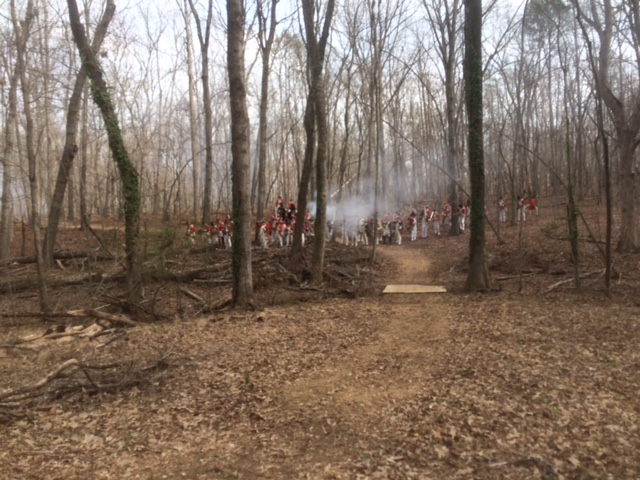
We had a good position in the creek bed and while only about one in ten of us were Continental veterans, we were prepared to give more than the "two volleys and light a shuck" that we had in the past.  Phillips advanced with two battalions of regulars, but we drove him back.  It was then that the Royal Artillery battery got into action and started playing havoc on our lines.


Phillips' artillery is brought into action against the first line at Poor's Creek.


We didn't know it at the time, but we were being turned.  Phillips sent the Queen's American Rangers and a battalion of light infantry to the south in a wide arc.  On the order from General Von Steuben, we retired in good order to the second line in Petersburg.


While Muhlenberg's four militia battalions held off Phillips' assault in Peterburg, Light Infantry
and the Queen's Rangers under LtCol John Graves Simcoe performed a turning movement to the south.


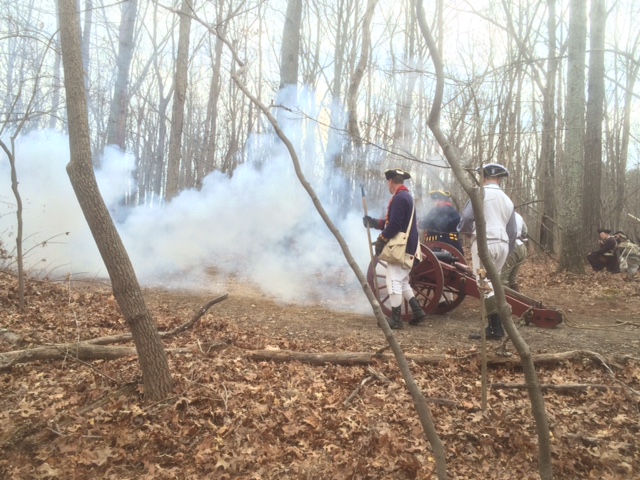
As the redcoats made their way through Blandford, our artillery came into action to cover our retirement from the heights on the north side of the Appomattox about a mile away.  They kept up the fire as we joined ranks with the two other battalions in Von Steuben's second line.


Virginia Artillery awaiting orders on the heights above Petersburg.


From there we held them for an hour and a half, repelling several attacks.  All the while, we knew nothing of LtCol Simcoe's turning our flank as he swept west towards the upper reaches of Lieutenant's Run.


Von Steuben ordered a withdrawal as the Tories were discovered to the west of the town.  The Virginians withdraw in good order across Pocahontas Bridge, but as British artillery ranged their retreating columns, order disintegrated.


At this point, we were hard pressed to the east and our scouts brought word that there were Tories in our rear.  We had given them a good showing and were ordered to withdraw across Pocahontas Bridge to the north side of the Appomattox, which, I am happy to say, we did in good order while under pressure from Tories and Redcoats. 


Civilian scouts often moved with the armies.  With a lack of accurate mapping,
local guides who new the roads and fords were essential well into the 20th c.
We covered each battalion as they marched across the bridge.  All was order until the British batteries ranged our line of retreat.  Then all was pandemonium.  We didn't get back into organized ranks for about two days, as it was every man for himself.  You might think this a shame, but it was the first time I saw militia stand for almost three hours against a foe twice in number, so you will have to excuse me if I choose to overlook our conduct on the north side of the river.  We also managed to get off the greater share of the military stores in the town.  All Phillips got for his effort was a warehouse of tobacco and that he burned, although on the march back, we hear he set the torch to many of the Virginia State Navy's vessels at Osborne's Landing on the James. 


****************************************************************


The recreation of the Battle of Petersburg was held for the 25th year at Battersea House, a palladian mansion that overlooks the Appomattox.  I have to say it was a little smaller of a turnout from years past, but I did manage to unhorse a dragoon again, spend the evenings in song, working on projects in camp and generally have a good time, riding my friends' horses around the property.


Working on a petticoat for my daughter in the militia camp.


Al Underwood and Gary O'Brien conduct a cavalry demonstration
for the visitors at Battersea.


I'll be back next year...but as a Queen's American Ranger.


For more detail on the Battersea House and the Battle of Petersburg go to: 


http://batterseafound.org/


http://www.vssr.org/speeches_articles/battle_of_peterburg.pdf


https://books.google.com/books/about/Simcoe_s_military_journal.html?id=uXgsAAAAMAAJ

Thursday, April 14, 2016

Battle of Guilford Courthouse (2016)


Retreat of the Virginia Militia (Greensboro Times) 


Again, it seems I'm posting weeks after the fact.  I suppose heading out to Battersea in Petersburg this weekend is an impetus, since I will have more to write about following that. We fell in with the 7th Virginia (Portraying Virginia Militia).   The recreated 7th is a great family-oriented mainstream unit from the Tidewater, Northern Va. and Northern Neck Area.  We'll be joining them again at Battersea this weekend as it seems the First Virginia (our normal home) will not be coming south.


A sorry-looking, passal of hayseed Virginians. 
We're supposed to stop Cornwallis with this?
Well, apparently Greene thought a lot of the Virginians that
Jefferson and Von Steuben sent south from
the training camps around Richmond and Chesterfield.


 Mike Cecere, the unit leader recently published another book in 2012 "Wedded to My Sword", about Harry Lee, available here.  I've read a few of Mike's other publications and they are excellently drawn from original sources.  As I mentioned, we portrayed Virginia Militia and as luck would have it I happened to meet a terrific young guy by the name of Matt Thompson.  He has an excellent Queen's American Rifles jacket made by Stuart Lilly.


Matt Thompson in the Stewart Lilly jacket.  Nice work.


 Why is this so important?  Aside from the fact that Stewart Lilly's reproductions are phenomenal, several friends and I are looking to develop a southern branch of the QAR Light Infantry and Matt and his nephew were interested.  At least not everyone in the unit will be pushing 40!


The Virginia Militia waits on Conrwallis' advance.

Bert Puckett and the Dragoons return from a flanking bit of sword and pistol play.

Erick Nason and the South Carolinians fall back under pressure from the Guards.

Disrupting the Guards' advance.

Advancing the Brigade of Guards against the Virginia First Line

My Virginia Militia impression.

Brigade of Guards at the Cornwallis Monument dedication.

Carl Ivar et Compagnie at the dedication.


Thursday, March 17, 2016

Militia Knapsack Construction: American War of Independence

Militia knapsack on a Virginia Militiaman in 1781. 
The extant pack is actually of Penna or New England origin...ah well.

This is my second attempt at this knapsack and I finally got the paint consistency correct.  The previous examples I constructed used pure modern oil paints, which are not the same consistency as 18th c oil paint and have enamel hardeners, apparently.  Out of the gate, my original packs were too stiff and eventually the paint cracked after a few years of use (which is a shame as they were made from vintage Irish linen canvas from Royal Navy hammock mattress covers).

Ready for assembly.  I used a heavy weight natural linen.
Acceptable for a pack, but too light for a tent.
For this run, I am mixing red and brown oil paint to get the ubiquitous "Spanish Brown" color. Linseed oil and turpentine were added to maintain flexibility an thin the paint.  I also added Japan drier and Tung Oil to speed the curing process (which took only two days).

Sewn inside out and turned.  As I begin making these for sale, I will use two
needles and a saddle stitch as it will make the seam stronger.

For the construction, I used hemp cord to sew the body (with a backstitch) and affix the straps (whipstitch).  I would recommend a saddle stitch in the future.


Close up of the backstitch.  I would finish off the corner by backing up the stitch for two inches.
I did the same at the opening of the bag as these two areas would see the most stress.

Placement of shoulder strap.  I used a whipstitch to close the seam as one would
when recreating the Uhl Knapsack.


The button holes and top stitching were completed with Burnley and Trowbridge's heaviest weight linen thread.  The pack was comfortable and I wore it for several hours during the reenactments of the Green Spring and Guilford Courthouse fights last week. One would think that the small straps (5/8 in) would cut into the shoulders, but as it is small, it doesn't hold so much that it is uncomfortable.  but the only addition I would make is tying a sternum strap across the front to keep the pack centered on the back.  If you carry a blanket, I would tie it with thongs to the straps at the top of the pack.


The completed knapsack
For more on period knapsack construction, I highly recommend the collections at Old Sturbridge Village, which are a bit after our time, but still relevant, files and notes on the Rev War Reenactors Facebook Page, and the article, "Cost of a Knapsack, Complete" by the incomparable John U. Rees.


Tuesday, March 15, 2016

240th Anniversary of the Battle of Moore's Creek, NC


Tory recruit and drummer from Cross Creek, enroute to Wilmington.
(I bought the knitted bonnets in Spain...go figure).

    Its been a busy, few weeks...well year for that matter.  So its no surprise that I'm writing about Moore's Creek (A great National Park, with a great staff) two weeks after the fact.  This was our first event on the Crown side and we fell in as Tories on their way from Cross Creek (Fayetteville) to Wilmington, NC.  These transplants from Scotland (veterans and sons of veterans of the rebellion of 1745) were being recruited to rendezvous with the Royal Navy and be transported north to Nova Scotia to be outfitted as a provincial regiment.  By the time they had reached the bridge at Moore's Creek, they had already marched over 90 miles, had few weapons (most who died in the battle were armed with the broadsword and pistols).

Moore's Bridge.  Prior to the battle, the Whigs tore up the boards on the bridge
and greased the stringers.  The Highlanders who actually made it across met with a hail
of cannon fire from a small earthen fort, recently thrown up by the Whig force.


   The battled ended in a Whig victory, but had two important results: Firstly, Wilmington did not fall into Crown hands and the future highland regiment was significantly depleted.  Negatively, the lopsided victory caused North Carolina to rely on militia levies for defense for the remainder of the war, never filling its Continental quota.  Once the war returned to the south, North Carolina was absolutely unprepared.


       While there was no battle recreation at the National Park, the NPS under the guidance of Ranger Matt Woods put on a great event.  The weekend kicked off with wreathlayings at the Scottish Tory and Whig monuments, attended by local Scottish Clan associations and the DAR.


         The rest of the weekend was filled with military demonstrations and colonial folkways-these were the best.  Moore's Creek staff has done a phenomenal job turning the field into an outdoor class room.


The last firing of the gun before its retirement to the museum.


At the outdoor kitchen, demonstrators talked about Colonial
foodways, while demonstrating 18thc baking and cooking techniques.

William Carter and Rick Sheets, horners, were very engaging and had beautiful work.


We were able to observe the making of lantern panes and spoons...as well as picking
up some valuable trade-secrets.


A few sutlers even made it out for the event.


Moore's Creek has a fully functional forge and a robust
blacksmith apprenticeship program...its all taken off in the last few years.

Add to this an 18th c soldier's garden and this really is a great site for an event, field trip
or home school day.


Non-period marshmellow roasting in sub-freezing temperatures.

 We had a wonderful time here, met some great people in the 71st and 84th Highlanders, with whom we fell in, and will certainly be back next year.  Perhaps with a little more kit that just a blew bonnet!


On our way to Wilmington LOL  #Godsavekinggeorge #Downwiththewhigs

Sunday, May 17, 2015

My Foray into 18th Century Shoemaking, or An Exercise in Humility


18th c shoemaker's shop.  Diderot

      You know what really burns me?  My kids grow.  Not normally a big deal, except when you have to remake a new set of 18th clothing for them every year.  I am not very interested in dropping over $100 for each of my companions on new shoes, so for a time we made do with 18th c "looking" shoes to which I could fix a buckle.  Now that they're older, we're going to juried events AND I'm not a fan of half measures, I decided to try my hand at making their shoes.  How hard can it be?  I'm making clothing, hunting pouches, hats, cartridge boxes, etc...right?  Wrong.  Whole different ballgame-but the good news is, I made all the mistakes for you.

       To start, with, I needed a source at which to look.  The shoes I made for my sons were based off my study (sadly only from photographs) of examples from Neumann and Kravic's Collector's Illustrated Encyclopedia of the American Revolution (below) and the Ligonier Collection (below inset).

8,9:  Excavated 18th c shoes (Neumann and Kravic), Inset: Round toed shoe (Fort Ligonier)
        For my materials I used a light suede for the uppers and heavy bridle leather for the heels and outsoles.  For the larger pair, I salvaged the heel and outsole from a pair of my old shoes, for the smaller pair, he heel leather was salvaged from an old cartridge box.  Each shoe was comprised of several pieces for which I took foot measurements and made patterns.

Anatomy of a shoe.  This shoe is for my teenager.  I cut down the outsole from a worn out
pair of my own shoes, moved the hobnails, made new stitching holes (in the outsole). 
The thread used is 40lb weight hemp cord.  The leather is suede, left over from a previous project.


         After tracing my child's foot, I added 1/2 in. all around.  This is the added area for the outer row of stitching on the welt.  I made the other pieces by looking at the angles and lengths on the extant shoes and drawing proportional patterns to my children's' feet.  Interestingly, the angles in the quarter are the same for both shoes, obviously the lengths and widths change.  The welt attaches the vamp and quarter to the insole and outsole.  In the photo above you will the welt stitched to the vamp and quarter.  I am about half way done stitching the welt to the outsole in this photo.  This is where I made my mistake.  After the welt is ENTIRELY stitched to the vamp and quarter, a wooden form should be inserted into the shoe to give it shape.  The insole is then whip stitched to the vamp and the form is extracted through the ankle hole.  This is important as I could have told very early that my vamps were too long and too wide (I had to take the first pair of shoes apart.  Additionally, I glued the insoles in place after construction ,which was messy AND inaccurate.

One of these shoes is NOT like the other.  (The vamp on the one on the right is too wide).

         In the photo above, you can see how much wider the first shoe turned out.  The second shoe (on the left) fit my son perfectly.  I tore apart the stitching on the right shoe, cut down the vamp by 1/2 in. on each side and sewed vamp, welt and outsole back together.  The finished product... not perfect, but looked much better (below).

           
Finished shoes for the teen (left).  Outsole and cut-out uppers for by 8 year-old at right.

         The outsole were made of two pieces of stacked and glued leather.  The heels were six stacked and glued pieces of leather as well.  To these I added nails from the bottom side.  The second pair of shoes went far more easily (having learned rom my mistakes on the first).  Nevertheless, I still failed to use a shoe form, nor did I use a hardened leather tow box.  You can tell by the lazy, dilapidated look of these shoes. 


Formless, shapeless... but they fit!

       So, these are certainly NOT Fugawee, but for about $30 a pair, I was able to make a pair of shoes (cheaper than modern shoes with rubber soles) that I won't be embarrassed about my boys wearing at a juried event.  Nor will I be upset when I have to make the next size up in twelve months.  The shoes were finished with Fiebing's black shoe dye and my blackball mixture using beeswax, turpentine, and meet's foot oil.  This gives them that waxed, rough out look (and makes them water resistant) like the original working class shoe.


Tuesday, May 12, 2015

The Leather Infantry Helmet


A few of the things I've been working on:  Completed infantry helmets, belly box,
and belt carriage


The panels prepared.  I found that significant wetting and stretching was required to fit. 
My estimation is that, with the headband and selvage on the leather, about 2 add'l inches
must be accounted for above head size.

The helmet sewn and turned rightside out. I wetted the helmet prior to turning
and stretched it out for two days, allowing it to dry thoroughly.

Interior suspension whip-stitched and tied.  This is more substantial that the typical
linen headband in period hats and keeps the helmet up off the crown,
as in a modern webbing or padding system.

Adding the rear flap.  Start at the center...I didn't and now its a bit crooked!


As you can see the finished interior also incorporates a sweat band
and the turned under portion of the rear flap, significantly reducing the interior circumference.

The finished cap.  I took the "liberty" of adding a black hemp tassel to the crown, as in the Newport Light Infantry Cap, and the black ostrich plume, which can be seen in a period British cartoon of an American Light Infantry Officer.


Friday, October 3, 2014

Journal of William Calk, Surveyor of Caintuck: 1775

Compass, Jacob's staff, gunter line (33 ft vice the standard 66)
and surveyor's notes of William Calk, Kentucky Historical Society


  William Calk (1740-1823) was recently mentioned by a friend on another page.  There is a great deal of information about his travels to "Caintuck" and "Knew Orlands" available in PDF format in various historical societies' archives.  He hailed from Prince William County Virginia was the surveyor of Boonsboro, Kentucky in 1775.  He traveled there with one Abraham Hank, the grandfather of a fellow with the last name of Lincoln and fell in with the company of a Captain Boone, as reads his journal below:

              "1775 March 13th mond I set out from prince wm. to travel to Cain- tuck on tuesday Night our company all Got together at Mr Prizes at Rapadan Which was ABraham hanks philip Drake Eanock Smith Robert Whitledge & my Self thear abrams Dogs leg got broke By Drake's Dog -

wedns 15th we started Early from prises made a good Days travel & lodge this Night at mr cars on North fork James River.

Entries of April from Calk's Journal, Kentucky Historical Society


thurs 16th we started Early it Raind Chief part of the Day Snowd in the Eavening very hard & was very coald we travld all Day & Got to Mr Blacks at the foot of the Blue Ridge


fryd 17th we Start Early cross the Ridge the wind Blows very hard & cold and lodge at James loyls

Satrd 18th we git this Day to William andersons at Crows ferrey & there we Stay till monday morning

mond 20th we Start early cross the fery and lodge this night at Wm adamses on the head of catauby

tuesd 21st we Start early and git over pepers ferey on new River & lidge at pepers this night.

 wedns 22d we Start early and git to foart chissel whear we git some good loaf Bread & good Whiskey

thurs 23d we Start early & travel till a good while in the Night and git to major cammels on holston River.

fryday ye 24th we Start early & turn out of the wagon Road to go across the mountains to go by Danil Smiths we lose Drive [Calk's black servant, presumably a slave] Come to a turabel mountain that tried us all almost to death to git over it & we lodge this night on the Lawrel fork of holston under a grait mountain & Roast a fine fat turkey for our Sup- pers & Eat it without aney Bread

Satrd 25 we Start Early travel over Some more very Bad mountains one that is caled Clinch mountain & we git this night to Danil Smiths on clinch and there we Staid till thursday morning on tuesday night & wednesday morning it Snowed Very hard and was very colad & we hunted a good deal there while we Staid in Rough mountains & Kild three Deer & one turkey Eanock ABram & I got lost tuesday night & it asnowing & Should a lain in the mountains had not I had a pocket Compas By which I Got in a littel in the night and fired guns and they heard them and caim in By the Repoart

thursd 30th we Set out again & went down to Elk gardin and there Suplid our Selves With Seed Corn & irish tators then we went on alittel way I turnd my hors to drive afore me & he got Scard Ran away t.hrew Down the Saddel Bags & Broke three of our powder goards & ABrams flask Burst open a walet of corn & lost a good Deal & made aturrabel flustration amongst the Reast of the horses Drakes mair ran against a sapling & noct it down we cacht them all agin & went on & lodgd at John Duncan

fryd 31st we suplayd our Selves at Dunkans with a 108 pounds of Bacon & went on again to Brileys mill & suployd our Selves with meal & lodged this night at clinch By a large cainbrake & cuckt our Suppers.

April satd first this morning there is ice at our camp half inch thick we Start Early & travel this Day along a verey Bad hilley way cross one creek whear the horses almost got Mired Some fell in & all wet their loads we cross Clinch River & travell till late in the Night & camp on cove creek having two men with us that wair pilates

Sund 2d this morning is avery hard frost we Start Early travel over powels mountain and camp on the head of Powels valey whear there is verey good food

mond 3d we Start Early travel down the valey cross powels River go some throw the woods with out aney track cross some Bad hils Git into hendersons Road camp on a creek in powels valey;

tuesday 4th Raney we Start about 10 oclock and git down to capt martins in the valey where we over take Coln. henderson & his companey Bound for Caintuck & there we camp this Night there they were Broiling & Eat- ing Beef without Bread;

Wednesday ye 5th Breaks away fair & we go on down the valey & camp on indian Creek we had this creek to cross maney times & very Bad Banks ABrams Saddel turned & the load all fell in we go out this Eavening & Kill two Deer

thurd 6th this morning is ahard frost & we wait at camp for Coln. henderson & companey to come up they come up about 12 oclock & we Join with them and camp there Still this night waiting for Some part of the companey that had their horses Ran away with their packs;

fryday ye 7th this morning is avery hard Snowey morning & we Still continue at camp Being in number about 40 men & Some Neagros this Eavening Comes aletter from Capt Boon at caintuck of the indians doing mischief and Some turns back

Satrd 8th We all pact up & Started Crost Cumberland gap about one oclock this Day we Met a great maney peopel turnd Back for fear of the indians but our Company goes on Still with good courage we come to a very ugly Creek With Steep Banks & have it to Cross Several times on this Creek we camp this night

Sunday 9th this morning We wait at camp for the cattel to Be drove up to Kill a Beef tis late Before they come & peopel makes out alittel snack & agree to go on till till Night we git to cumberland River & there we camp meet 2 more men turn Back

Monday 10th this is alowry morning & very like for Rain & we keep at camp this day and Some goes out ahunting I & two more goes up avery large mountain Near the top we Saw the track of two Indians whear they had lain unter Some Rocks Some of the companey went over the River a bofelo hunting But found None at night Capt. hart comes up with his packs & there they hide Some of thier lead to lighten thier packs that they may travel faster (Were they carrying lead ingots to Boonsboro for the casting of ball?)

tuesday 11th this is a very loury morning & like for Rain But we all agree to Start Early we Cross Cumberland River & travel Down it about 10 miles through Some turrabel Cainbrakes as we went down abrams mair Ran into the River with Her load & Swam over he followd her & got on her & ma.de her Swim Back agin it is a very Raney Eave- ning we take up camp near Richland Creek they Kill a Beef Mr Drake Bakes Bread with out Washing his hands we Keep Sentry this Night for fear of the indians-

Wednesday 12th this is a Raney morning But we pack up & go on we come to Richland creek it is high we toat our packs over on a tree & swim our horses over & there We meet another Companey going Back they tell Such News ABram & Drake is afraid to go aney further there we camp this night-

thursday 13th this morning the weather Seems to Brake & Be fair ABram & Drake turn Back we go on & git to loral River we come to a creek before wheare we are obliged to unload & to toate our packs over on alog this day we meet about 20 more turning Back we are obligd to toat our packs over loral River & Swim our Horses one hors Ran in with his pack and lost it in the River & they got it [back]

fryday 14th this is a clear morning with a Smart frost we go on & have avery mirey Road and camp this Night on a creek of loral River & are Surprisd at camp By a wolf-

Satterday 15th clear with a Small frost we Start Early we meet Some men that turns & goes With us we travel this Day through the plais Cald the Bressh & cross Rockease River & camp ther this Night & have fine food for our horses-

Sunday 16th cloudy & warm we Start Early & go on about 2 mile down the River and then turn up a creek that we crost about 50 times Some very Bad foards with a great Deal of very good land on it the Eavening we git over to the Waters of Caintuck & go alittel Down the creek & there we camp keep Sentry the forepart of the night it Rains very har[d] all night-

monday 17th this is a very Rany morning But Breaks about 11 oclock & we go on and Camp this Night in Several companeys on Some of the creeks of caintuck

tuesday 18th fair & cool and we go on about 11 oclock we meet 4 men from Boons Camp that Caim to cunduck us on we camp this night Just on the Beginning of the Good land near the Bluie lick they kill 2 Bofelos this Eavening-

This Wednesd 19th Smart frost this mornling they kill 3 Bofelos about 11 oclock we come to where the indialns fired on Boons Companey & Kild 2 men & a dog & wounded one man in the thigh we campt this night on oter creek-

thursday 20th this morning is Clear & cool We Start Early & git Down to Caintuck to Boons foart about 12 oclock wheare we stop they Come out to meet us & welcom us in with a voley of guns

fryday 21st Warnm this Day they Begin laying off lots in the town and prearing for peopel to go to worek to make corn- [Calk begins his Survey]

Satterday 22d they finish laying out lots this Eaveninlg I went afishing and Cacht 3 cats they meet in the night to Draw for choise of lots But Refer it till morning-

April Sunday 23d this morniing the peopel meets & Draws for Chais of loots this is avery warm day monday

24th We all view our loots & Some Dont like them about 12 oclock the Combsses come to town & Next morning they make them abark canew and Set off down the River to meet thier Companey-

tuesday 25th in the Eavening we git us a plaise at the mouth of the creek & Begin clearing this day we Begin to live with out Bread

Wednesday 26th We Begin Building us a house & a plaise of Defenee to keep the indians off

thursday 27th Raniey all Day But We Still keep about our house-

Satterday 29th We git our house kivered with Bark & move our things into it at Night and Begin houskeeping Eanock Smith Robert Whitledge & my Self

monday May ye first I go out to look for my mair and Saw 4 Bofelos the Being the first Ever I Saw & I shot one of them but did not git him when I caim home Eanek & Robin had found the mair & was gone out ahunting & did Not Come in for Days and kild only one Deer-

tuesday 2d I Went out in the morning & kild aturkey and come in & got Some on for my Breakfast ancd then went & Sot in to Clearing for Corn-" - Mississippi Historical Review